
Why is this copper red? How hido gets its colour
This is an English translation of our Japanese article. Read the original (Japanese)
After we posted a video of how hido is made, we received comments like “beautiful” and “I had no idea copper could turn this colour.”
When you hear “copper,” you probably picture the colour of a Japanese 10-yen coin.
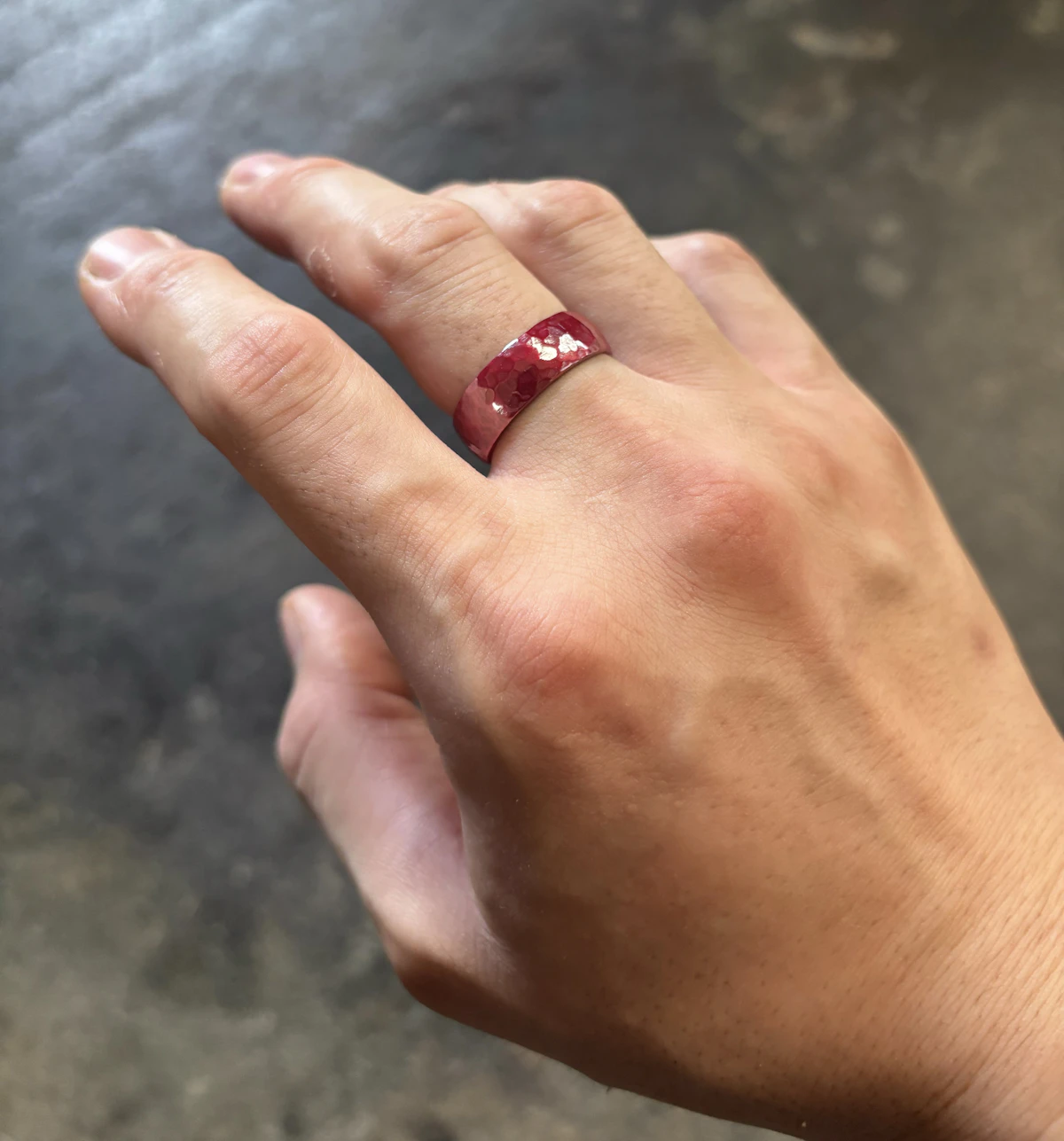
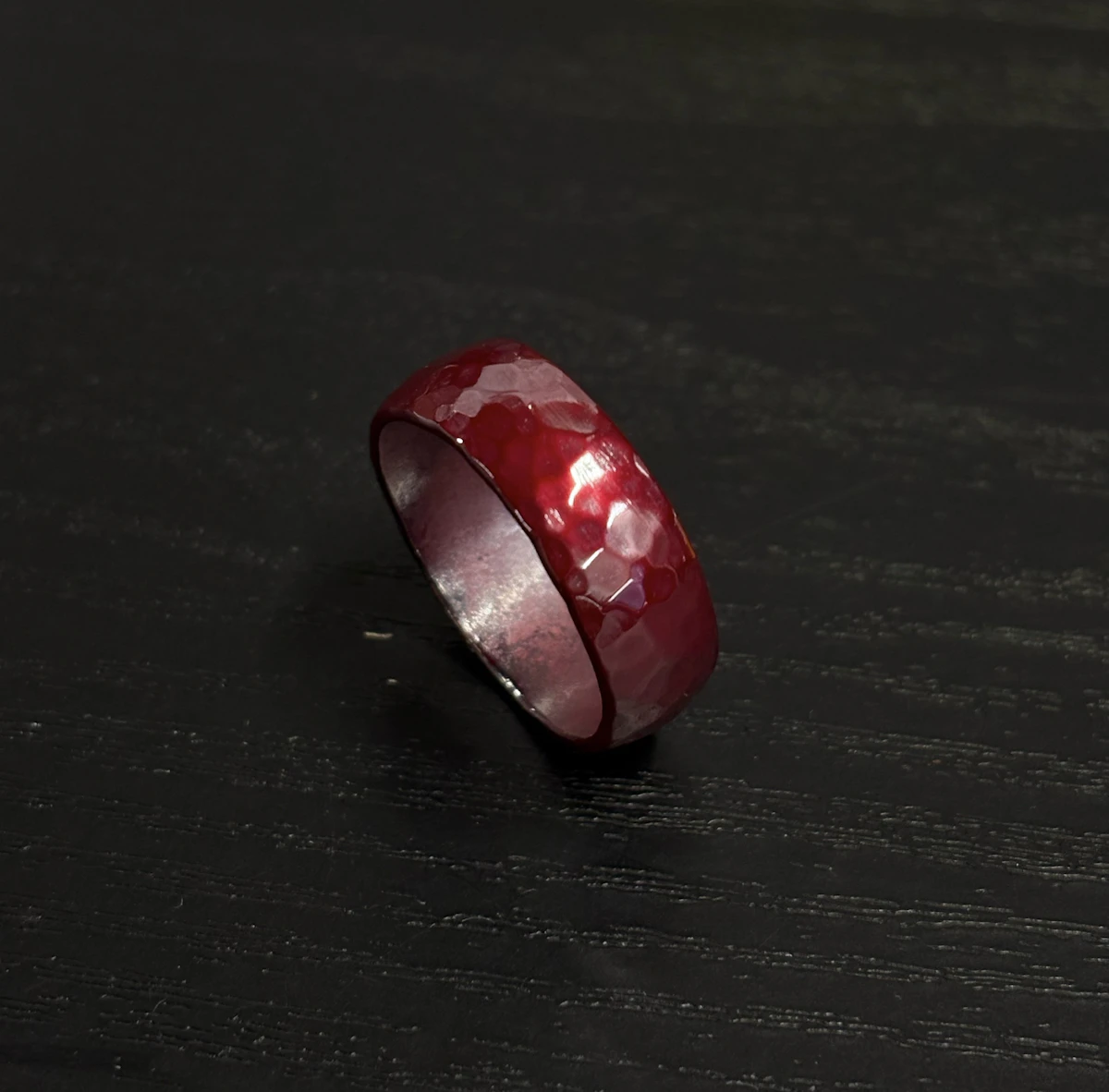
That may not connect right away with the deep red of this ring.
It is not painted, and it is not dyed. The copper itself produces this colour.
What is hido (緋銅)?
Hido is an old metalworking technique said to have originated in the Edo period. Copper is heated close to its melting point (about 1,000 °C) and quenched in a solution in which chemicals have been dissolved, so that a thin red oxide film forms on the surface and turns it red.
“Hi” (緋) refers to hiiro, scarlet: a deep red with a slightly muted tone.
It is not paint or plating. The red of hido is a colour born when the surface of the copper itself changes. It is very delicate: as you wear it, rubbing and knocks gradually wear the red away from the surface, and the ring ages like an antique.
The final colour and unevenness change with many conditions — how the heat goes in, the temperature, the time before the piece goes into the solution, the strength of the solution, and more. That is why every hido piece has its own expression, almost like a living thing in nature.
How a hido ring is made
1. Forming
We shape the ring from copper stock. The thickness, the width and the amount of hammer marks or roundness are all decided here.
2. Surface treatment and polishing
Before the colour is brought out, we prepare the surface. The state of the surface at this stage shows directly in the final colour. Any spot left unpolished, or any oil left behind, changes the colour in that spot alone — so it is a plain step that largely decides the result.
3. Heating and colouring
We apply the flame. This is the difficult part of hido.
4. The colour changes
As the heat goes in, the colour of the copper surface shifts. We judge the temperature by feel, watching the colour of the surface. That judgement is everything.
5. Into the solution in an instant
The longer heated copper stays in contact with the air, the more likely it is to turn black. So the moment the flame is taken away, the copper has to be quenched at once. It boils; after the bubbles stop, and after a moment of silence, it turns crimson all at once.
Why hido is difficult
Even when we make two rings in the same way, they never come out with the same colour or texture. Not only do they differ — if the temperature is wrong, the copper turns blackish, or the surface melts and turns rough, and the ring becomes a reject.
The main reason is that we cannot make the heating conditions the same every time. The angle of the flame, how long it is applied, the thickness and size of the base metal, where the heat spreads from. Even when we think our hands do the same thing, every piece comes out differently.
There is also a second problem, which comes from the structure of the technique. When copper is heated, it is annealed and becomes soft — soft enough to bend easily with a finger. Copper after colouring is too soft to wear every day as a ring. So a step to restore its hardness (work hardening) is needed.
Restoring only the hardness without damaging the coloured surface — that is the step we take the most care over when making a hido ring.
A finished hido ring
A wide ring has surface area, so its shading and unevenness become its expression just as they are.
In person, the red has more depth than it does in photographs.
Why TESSAI also works with materials other than iron
TESSAI is a brand with iron as its main material. We also work with copper, brass, leather and wood, but iron is always at the centre.
We use other materials to bring out the iron. If you build only with iron, its blackness and texture sink, with nothing to compare against. Add the red of copper, the gold of brass and the warmth of wood, and the expression of the iron stands out clearly.
Every material has an expression of its own. We bring it out by hand, without erasing it.
An expression born of human hands, in inorganic materials — that is what TESSAI wants to make.
Each hido is different
“Red” covers a range. Some pieces lean toward a bright red; others sink into a reddish purple.
The way it looks also changes with the light. The same ring looks like a different colour under indoor lighting and in sunlight outdoors.
Even when we follow the same steps, the result is never exactly the same. In the sense that we cannot aim to make pieces match, this is a flaw. At the same time, it is the reason the one that reaches you is the only one of its kind in the world.
Seeing it in person
We plan to exhibit at events, mainly in Tokyo.
Hido changes its impression between a photograph and the real thing. There is depth, colour and unevenness that a screen cannot show in full, so if you have the chance, please pick one up.
We announce our exhibition schedule on Instagram.
Notes on hido rings
We can currently make mainly open-type rings. Because of how we source our material, the sizes in which we can make closed (band-type) rings are limited, so thank you for your understanding.
Because of the production process, each piece varies a great deal. Unevenness, light flaking of the surface and bumps are very hard to control.
If you want to buy outside an event, please do so only if you can accept such individual differences when the ring arrives.
We recommend checking the actual piece at an event before you buy, whenever you can.